

New research across millions of AI citations confirms what many suspected but couldn’t yet prove: the companies showing up in AI-generated answers aren’t there by accident. They got there through strong foundational SEO, and the gap is widening.
There is a question every marketing director and business owner should be asking right now: when someone searches for what your company offers through an AI assistant, ChatGPT, or in a search engine dominated by features like Google’s AI Overviews, does your brand appear in the answer?
For most companies, the answer is… probably not as often as you’d like. From research that has emerged over the past 18 months and in our own findings with our clients, it’s clear why.
Visibility in AI-generated answers is not random, not primarily about prompt engineering, and not disconnected from traditional SEO. In fact, the strongest predictor of whether your content gets cited by an AI answer engine is the quality of your foundational search engine optimization.
For everyone shouting that AI will be the death of SEO, we’re not buying it here at Analytics Answers. If anything, this means SEO is even more important when it comes to your digital visibility.
The New Search Landscape & What GEO and AEO Actually Mean
Before examining the data, let’s define what we’re talking about. With the evolution of search, we’re seeing an evolution of terms. GEO, Generative Engine Optimization, and AEO, Answer Engine Optimization, are two of the more popular terms, but they are all just an evolved version of SEO, Search Engine Optimization.
AI answer engines are not a single product. The landscape includes Google’s AI Overviews and AI Mode (integrated into traditional search results), standalone LLM assistants like ChatGPT and Perplexity with web retrieval, and an expanding range of AI-powered research tools that synthesize and regenerate information from multiple sources.
These systems produce different kinds of outcomes:
Citations – When the AI returns an answer and includes a direct link to your page as a source. This is the “featured snippet” of the AI era. It’s visible, credible, and increasingly driving decision-maker behavior.
Mentions – These occur when the AI names your brand in its answer text without linking to you. It’s useful for brand awareness, but harder to convert. Share-of-voice metrics are composite scores that track how often your brand appears across large volumes of AI queries, which enterprise-level tracking tools now measure routinely.
These distinctions matter because they have different drivers. The research is clear that you need a strategy addressing both, and that they don’t respond to the same interventions.
What Google Says Directly About AI Overviews
Google’s own documentation on AI Overviews states plainly: to be eligible as a supporting link in an AI Overview or AI Mode answer, a page must be indexed and eligible to appear with a snippet in standard Search results. There are no special markup files or AI-specific optimizations required beyond foundational SEO.
That single policy statement from Google means that before any discussion of content strategy, AI optimization, or generative engine tactics, there is a prerequisite. Your website needs to be technically sound. Sound familiar? I bet your technical SEO pro has, on more than one occasion, bugged (maybe even begged) your engineering team to make changes.
The Analytics Answers SEO & AI Search Approach
At Analytics Answers, we’ve been working with websites for decades and implementing SEO best practices for nearly as long. We’ve stayed curious, but cautious as we watch the AI search world evolve. When we enter a business relationship with a new client, our first steps involve an audit.
We assess and remediate crawlability, indexability, canonicalization, and page structure. These are the hard prerequisites for any AI citation eligibility in Google’s systems. Next, we look at existing topical authority and build a content strategy, knowing that we need a breadth of coverage across your topic area.
Our writing team is available to lay the foundation for your traditional SEO and AI strategy. We work on E-E-A-T signal building with author credentialing, data sourcing, and third-party validation strategies. We also have skilled SEO consultants to work with your writers and marketing team.
SEO Rankings and AI Citations Are Colliding
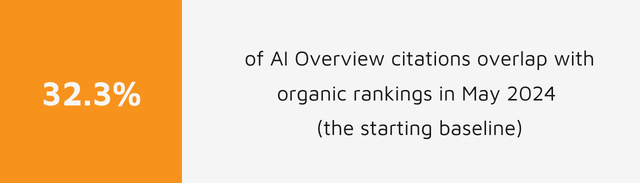
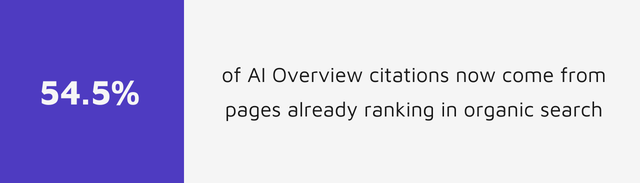
BrightEdge held a 16-month study spanning nine industries and millions of data points. The biggest finding is that the overlap between pages cited in Google AI Overviews and pages that already rank organically in traditional search grew from 32.3% in May 2024 to 54.5% by September 2025.
More than half of all AI Overview citations now go to pages that are already ranking in traditional search. And that percentage has been climbing steadily for over a year. The companies that built strong organic search positions over the past decade are increasingly reaping a second dividend, visibility in the AI layer that sits above traditional results.
This is not a coincidence. It reflects the underlying architecture of how AI systems work. They are built on top of the same indexing and ranking infrastructure that powers traditional search. Companies that invested in SEO have a foundation that now serves double duty.
Where You Rank Still Determines Whether AI Picks You
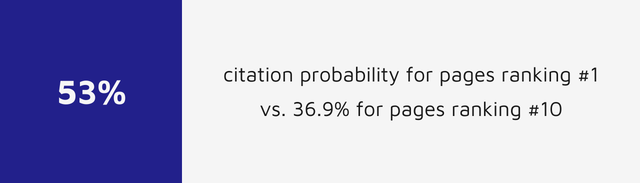
Independent research by Authoritas (published by analyst Rich Sanger) adds important granularity to the ranking question. Looking at the same set of queries across both traditional and AI results, they found that a page ranking #1 in traditional search has roughly a 53% probability of being cited in an AI Overview for that query. A page ranking #10 has a 36.9% probability.
That 16-point gap matters. It means that for any given query your business targets, the difference between a first-page top ranking and a bottom-of-page ranking translates directly into meaningfully lower AI visibility. The investment in improving your organic rankings isn’t just about traditional search clicks anymore. It’s compounding into AI citation probability.
As we dive in, we have to understand AI’s use of “query fan-outs”. The system runs multiple related searches across subtopics to pull together a comprehensive answer. Why is this important? It means that topical depth matters. You are not just ranking for a single exact keyword anymore.
When Authoritas extended its analysis to include these related and reformulated queries, the overlap between organic rankings and AI citations rose to 67.3%. Companies with deep content covering many angles of a topic have an inherent advantage.
How You Write Determines Whether AI Can Use Your Content
Beyond technical eligibility and topical depth, a large-scale Semrush study published in 2025 provides the most detailed breakdown of what separates content that gets cited from content that doesn’t, even among pages that already rank.
The study compared 304,805 AI-cited URLs against a baseline of 921,614 pages already ranking in the top 20 organic results. Because the comparison group was itself already-ranking pages, this isn’t simply “SEO vs. no SEO”. It’s the additional content qualities that determine whether a ranking page gets selected for AI citation. These are the differentiators:
Clarity & Summarization +32.83%
E-E-A-T Signals (expertise, authority, trust) +30.64%
Direct Q&A Formatting +25.45%
Clear Section Structure / Headers +22.91%
Structured Content Elements +21.60%
Writing Style Consistency +7.76%
Non-Promotional Tone −26.19%
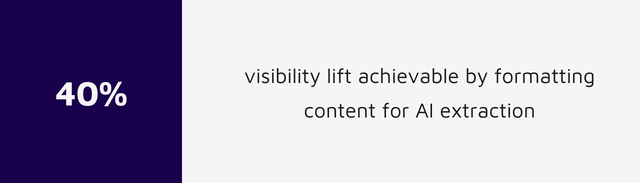
AI engines favor content that leads with a direct answer, states its claims clearly, and provides supporting evidence in an organized, extractable form. This is nothing new for anyone in the SEO world. Instead of chasing featured snippets and People Also Ask answers with a direct answer, we’re now chasing AI citations.
The E-E-A-T finding (expertise, experience, authoritativeness, trustworthiness) is equally significant for businesses that operate in competitive or regulated industries. Content that demonstrates real expertise, through cited data, attributed claims, author credentials, and factual specificity, is substantially more likely to be selected than content that reads like it could have been written by anyone. Again, any SEO knows the value of E-E-A-T, especially after the October 2023 Core Update.
The negative association with “non-promotional tone” is frequently misread. It does not mean you should make your content more promotional. It means that pages heavy in marketing language and light on extractable information are penalized relative to pages that lead with substance. The practical implication: your blog content, your resource pages, and your educational content need to be genuinely informative, not thinly veiled sales pitches.
Your Industry Determines How Much Your SEO Maturity Matters
The BrightEdge study also reveals something critical for business strategy: the relationship between traditional SEO and AI citation is not uniform across industries. The correlation is much stronger in some verticals than others.
The data suggests that getting your SEO house in order is the most direct lever available for improving AI visibility for companies in healthcare, education, B2B tech, and insurance. These are sectors where Google applies stricter quality and trust signals (what Google refers to as “YMYL” — your money or your life content), and where the AI system leans heavily on the same authority signals it uses for traditional ranking.
For industries in the low-convergence group, the picture is more complex. Finance and restaurant queries, for instance, show AI systems drawing significantly from third-party review platforms, aggregators, and community sources, not just brand-owned pages. In these verticals, earned media strategy, like getting your brand featured in the sources AI trusts, becomes a co-equal priority alongside your owned website’s SEO.
The Third-Party Blind Spot of AI Citing Sources You Don’t Own
Here is where the picture becomes strategically more complex, and where many agencies fall short in their AI visibility strategies.
Your SEO foundation determines whether your pages can be selected. But where AI systems look for authoritative “truth” is often not your website. It’s the review sites, forums, industry publications, and knowledge bases that talk about you. When looking at how and where AI platforms gather data, the more detailed a mention of your brand, the more likely AI is to ingest it and regurgitate it. Unfortunately, even if it’s false.
Cross-platform research from Profound, analyzing citation patterns across multiple AI systems, found that the dominant cited sources differ by engine, with each platform reflecting its own ecosystem biases.
For marketing directors, this has a concrete implication: a complete AI visibility strategy has two tracks.
- On-site track – Technical SEO health, deep content, structured writing, topical authority.
- Earned media track – Active management of your presence on the third-party sources AI engines trust. This means your presence on review platforms, your Wikipedia entry if one exists, your coverage in industry publications, and your footprint in the communities where your buyers seek information.
SEO Is the Price of Entry for AI Visibility
Your website needs to be technically sound, topically authoritative, and content-rich. If not, you are not eligible to compete for AI visibility in Google’s systems. That’s not a strategic disadvantage. It’s a disqualification. The companies currently dominating AI answer results in your industry didn’t get there through prompt hacks or AI-specific tricks. They built strong SEO foundations over time, and those foundations are now serving double duty.
The window for a meaningful first-mover advantage in AI search visibility is still open. The convergence between traditional rankings and AI citations has been growing for 16 months straight. That trend line is not reversing. The question for your business is not whether to invest in this. It’s whether to start now or wait to catch up to your competitors who have built an expensive lead.
Sources & Citations
- Google Search documentation – AI Overviews and AI Mode inclusion criteria: developers.google.com/search/docs/appearance/ai-features
- BrightEdge, 16-month AI Overview citation overlap study: brightedge.com — Rank Overlap After 16 Months of AIO
- Authoritas / Rich Sanger, AI Overview link selection study: richsanger.com
- Semrush, AI search visibility study findings: semrush.com/blog/ai-search-visibility-study-findings/
- Aggarwal et al., “GEO: Generative Engine Optimization,” KDD’24: arxiv.org/pdf/2311.09735
- Google Search Central, “Creating Helpful, Reliable, People-First Content” E-E-A-T and people-first content guidelines: developers.google.com/search/docs/fundamentals/creating-helpful-content
- Makosiewicz, M. “I Ran an AI Misinformation Experiment. Every Marketer Should See the Results.” Ahrefs Blog. https://ahrefs.com/blog/ai-vs-made-up-brand-experiment/
- Profound, cross-platform AI citation patterns: tryprofound.com/blog/ai-platform-citation-patterns